

The story of copyright that most people know is a simple one: creators make work, others use it, and the law ensures they are paid for it. But that account leaves out the layer of intermediaries sitting between the artist and the venue — the licensing companies, the collection agencies, and the self-styled “societies” that have, in practice, turned a system meant to reward creators into one built on ambiguity, delayed enforcement and the threat of litigation.

Double Taxation Avoidance in India: When One Income Attracts Two Tax Demands
Taxation & Cross-Border Law Double Taxation Avoidance in India: When One Income Attracts Two Tax Demands Lynx Legal Partners LLP · Insights A software engineer from Bengaluru accepts a two-year assignment in Singapore. Her salary is taxed there because she works and earns in Singapore. When she files her tax return in India, she receives another tax demand on the same income because she continues to qualify as a tax resident in India. A simple question follows: should one income be taxed twice merely because two countries claim the right to tax it? This is not an uncommon dilemma. As businesses expand across borders and professionals increasingly work, invest and trade internationally, the possibility of the same income being taxed in multiple jurisdictions has become a practical legal problem. Without a clear legal framework, international commerce would become economically inefficient and taxpayers would face unfair financial burdens. The problem arises because countries adopt different principles for taxation. Some countries tax income based on the source principle, meaning income earned within their territory is taxable irrespective of the taxpayer’s residence. Others, including India, also apply the residence principle, under which residents are taxed on their global income as defined under Section 5 of the Income-tax Act, 1961. When both principles operate simultaneously, the same income may fall within the tax jurisdiction of two countries, creating what is known as double taxation. Double taxation is not merely a financial inconvenience. It discourages foreign investment, increases compliance costs, distorts business decisions and often results in prolonged tax disputes. More importantly, it contradicts the fundamental objective of tax law, which is to collect legitimate revenue without imposing arbitrary or excessive burdens. Recognising this challenge, India has entered into Double Taxation Avoidance Agreements (DTAAs) with numerous countries. These bilateral treaties allocate taxing rights between two sovereign states and ensure that the same income is not subjected to tax twice. Their objective is not to eliminate taxation altogether, but to determine which country should tax a particular income and to what extent. The treaty supplements domestic law while protecting taxpayers against excessive taxation. The legal foundation for these agreements lies in Section 90 of the Income-tax Act, 1961, which empowers the Central Government to enter into tax treaties with foreign countries. Additionally, Section 91 provides unilateral relief in cases where no DTAA exists. Section 90(2) provides an important taxpayer-friendly safeguard: where the provisions of the Income-tax Act and the DTAA differ, the taxpayer may rely upon whichever provision is more beneficial. Thus, the treaty supplements domestic law while protecting taxpayers against excessive taxation. A DTAA addresses practical issues through clearly defined mechanisms. The first is the tax credit method, where the country of residence allows credit for tax already paid in the source country, subject to rules prescribed under Rule 128 of the Income-tax Rules, 1962. For example, if an Indian resident has already paid tax in the United Kingdom on rental income situated there, India ordinarily permits a credit against its own tax liability, thereby preventing double taxation. The second mechanism is the exemption method, under which one country agrees not to tax a particular category of income because the other country has already exercised its taxing rights. Although India predominantly follows the tax credit method, exemption provisions exist under certain treaties and for specified categories of income. Another significant feature of DTAAs is the allocation of taxing rights for different classes of income, including salaries, dividends, royalties, interest, capital gains and business profits. In determining where business profits should be taxed, treaties often employ the concept of a Permanent Establishment (PE), which is also reflected in Explanation 2 to Section 9(1)(i) of the Income-tax Act. Simply earning revenue from another country does not automatically create tax liability there. Taxation generally arises only when the enterprise maintains a sufficient economic presence, such as a fixed place of business. However, DTAAs are not instruments for tax evasion. Their purpose is to prevent double taxation, not double non-taxation. To curb treaty abuse, India has strengthened its legal framework through the General Anti-Avoidance Rules (GAAR) under Chapter X-A (Sections 95 to 102) and the Multilateral Instrument (MLI) developed under the OECD’s Base Erosion and Profit Shifting initiative. These measures prevent taxpayers from engaging in treaty shopping or creating artificial arrangements solely to obtain treaty benefits. For taxpayers, the practical lesson is straightforward. Whenever income has a foreign element, three questions should be asked before determining tax liability. First, what is the individual’s residential status under Indian tax law as per Section 6 of the Income-tax Act? Second, does India have a DTAA with the other country? Third, what relief does the treaty provide for that particular category of income? These questions often determine whether tax is payable once, twice, or only after claiming appropriate relief. Ultimately, Double Taxation Avoidance Agreements represent more than technical tax instruments. They embody a balance between the sovereign taxing powers of nations and the principle of fairness owed to taxpayers. In an increasingly interconnected global economy, certainty in taxation is as important as taxation itself. By reducing conflicts between jurisdictions and encouraging cross-border investment, DTAAs reinforce a simple legal principle: the law should tax income fairly, but never punish international mobility by taxing the same income twice. SP Written by Shreya Pandey

Understanding Tax Compliance for Non-Profit Organizations (NGOs) in India
Corporate & Regulatory Compliance Understanding Tax Compliance for Non-Profit Organizations in India Why tax-exempt status is earned, not assumed — and what Section 12AB and Section 80G mean for institutional credibility. Introduction Non-Profit Organizations (NPOs) are vital to India’s socio-economic growth, addressing critical societal gaps in healthcare, education, and community welfare. However, as this sector expands, maintaining a highly transparent and accountable regulatory framework is essential to preserve public trust. Though NPOs prioritize public service over commercial profit, they are not automatically exempt from taxes. In India, tax-exempt status is strictly contingent upon complying with the Income-tax Act, 1961 and the specific regulations governing an organization’s chosen legal structure. Ultimately, tax compliance is the bedrock of institutional credibility. Timely registrations, accurate record-keeping, and transparent financial reporting are crucial to safeguarding tax benefits, boosting donor confidence, and ensuring long-term operational sustainability. Understanding Non-Profit Organizations: The Legal Structure In India, non-profit organizations are established under three primary legal frameworks tailored to their specific operational goals and governance needs: Section 8 Companies (Companies Act, 2013): These function as corporate entities with a separate legal identity and perpetual succession. They are highly favoured by organizations that prioritize institutional transparency and corporate credibility. Public Charitable Trusts: Formed through a trust deed, these entities are managed by dedicated trustees to execute specific philanthropic mandates under relevant trust laws. Registered Societies (Societies Registration Act, 1860): Governed by an elected board, these are a popular choice for cultural, educational, literary, and social welfare projects. Because this initial choice directly impacts an organization’s regulatory burden, governance, and flexibility, founders must carefully align their legal structure with the scale of their long-term vision. This foundation is essential for successfully managing the broader tax and legal compliance obligations required of Indian non-profits. The regulatory framework for Indian non-profits is spread across multiple statutes that govern their structure, daily administration, and tax status. An organization’s specific legal obligations depend heavily on its chosen legal format and the activities it conducts. A Section 8 Company must comply with the strict corporate governance and annual filing mandates of the Companies Act, 2013. Conversely, Public Charitable Trusts and Registered Societies are bound by state-specific trust laws and the Societies Registration Act, 1860, respectively. From a fiscal standpoint, the Income-tax Act, 1961 is the central authority governing tax exemptions. It outlines the strict criteria required to secure and retain tax-exempt status on income. Additionally, it governs the approvals needed to offer tax deductions to donors, which is vital for fundraising. Ultimately, compliance is a dual responsibility. To operate smoothly, Indian NPOs must continuously align their internal governance dictated by their founding legislation with the rigorous statutory demands of federal tax laws. Tax Registrations and Compliance Requirements Securing registrations under the Income-tax Act, 1961 is crucial for any Indian non-profit aiming to access tax exemptions and build trust with donors. The two most vital certifications are Section 12AB and Section 80G, each serving a distinct fiscal purpose: Section 12AB Registration This directly benefits the NPO by allowing it to claim exemptions on its institutional income. Rather than being a lifetime pass, this status requires periodic renewals and continuous adherence to statutory guidelines to remain valid. Section 80G Registration This acts as a powerful fundraising tool by benefiting the donor. It permits eligible contributors to claim tax deductions on the donations they make to the organization. While Section 12AB secures the organization’s internal tax immunity, Section 80G incentivizes external philanthropy. Consequently, most successful non-profits secure both registrations simultaneously. Far from being simple administrative paperwork, obtaining these twin approvals is a foundational strategic step to ensure long-term financial sustainability and establish robust institutional credibility. Securing registrations under Sections 12AB and 80G is merely the beginning; retaining these tax benefits requires continuous adherence to the Income-tax Act, 1961. At the core of ongoing compliance is the maintenance of flawless, comprehensive books of account that track all income, expenditures, assets, and liabilities. These records ensure operational transparency and form the basis for mandatory statutory audits and timely tax filings. Furthermore, NPOs must strictly apply their income toward their defined charitable objectives. Every transaction must be transparent, well-documented, and free from personal enrichment. Organizations must also remain vigilant about filing deadlines, proactively manage the periodic renewal of their tax registrations, and immediately report any material changes in their governing structure or operational focus to the authorities. Conclusion In the end, regulatory compliance for Indian non-profits must be viewed not as a sporadic administrative chore, but as an ongoing, daily dedication to operational integrity. By systematically prioritizing airtight financial records and robust internal governance, organizations protect their vital tax-exempt status from potential revocation. Ultimately, embracing this rigorous culture of compliance is what secures an NPO’s financial sustainability, allowing its developmental mission to thrive for years to come. NPO Tax Compliance India Section 12AB Section 80G Registration Income Tax Act 1961 Section 8 Company Charitable Trust Non-Profit Governance Donor Tax Deduction RD Written by Riwan Douly

FSI and TDR in Mumbai Redevelopment
FSI and TDR in Mumbai Redevelopment | Lynx Legal Urban Law & Real Estate FSI and TDR in Mumbai Redevelopment By Srishti Rai Lynx Legal Partners Mumbai is one of the most densely populated cities in India, where limited land availability and rising housing demand have made redevelopment a critical engine of urban growth. In this complex landscape, two concepts play a decisive role — Floor Space Index (FSI) and Transferable Development Rights (TDR). Across the city, old buildings, ageing housing societies, and slum areas are being transformed into modern residential and commercial projects. FSI determines how much construction can legally take place on a plot of land, while TDR allows development rights from one property to be transferred and used on another. Together, they form the foundation of Mumbai’s redevelopment and urban planning system, helping the city manage growth despite increasing population pressure and land scarcity. What is FSI? Floor Space Index (FSI), also known as Floor Area Ratio (FAR), refers to the ratio between the total built-up area of a building and the total area of the plot on which it is constructed. The Formula FSI = Total Built-up Area ÷ Plot Area For example, if a plot area is 1,000 sq. ft. and the permissible FSI is 1.5, then: 1,000 × 1.5 = 1,500 sq. ft. of total permissible construction — distributed across different floors. In simple words, FSI tells developers how much they are allowed to build on a particular piece of land. Why is FSI Important in Mumbai? Mumbai has extremely high population density and limited land availability. The city cannot expand horizontally on a large scale. To manage urban growth properly, the Brihanmumbai Municipal Corporation (BMC) regulates construction through FSI under the Development Control and Promotion Regulations (DCPR), 2034. FSI is important because it helps: Control excessive construction Maintain balance between open spaces and buildings Regulate population density Reduce pressure on infrastructure Support planned urban development For redevelopment projects, higher FSI is extremely beneficial because it allows developers to construct additional saleable area after rehabilitating existing occupants. Factors Affecting FSI in Mumbai The permissible FSI in Mumbai depends upon several factors such as: Location of the property Width of adjoining roads Size of the plot Type of construction Availability of infrastructure and amenities Nature of redevelopment project Generally, areas with wider roads and better infrastructure are allowed higher FSI. Types of FSI in Mumbai 1. Base FSI Base FSI is the standard permissible FSI available on a plot without paying additional premiums. In Mumbai, South Mumbai generally has base FSI around 1.33 to 1.35, suburban areas usually have base FSI around 1.35, and commercial zones may have slightly higher limits. 2. Premium FSI Premium FSI allows developers to purchase additional construction rights by paying premium charges to the municipal authority. Example Calculation Base FSI (1.35) + Premium FSI (0.65) = Total FSI: 2.0 This significantly increases the construction potential on any given plot. 3. Fungible FSI Fungible FSI provides additional construction space for balconies, staircases, flower beds, refuge areas, and utility spaces. Residential buildings generally receive 35% additional fungible FSI, which helps improve building design and planning. Permissible FSI in Mumbai The permissible FSI in Mumbai usually depends on road width and plot size: Width of Road Minimum Plot Size Maximum Permissible FSI 9 – 12 metres Below 1,000 sq. m. 2 12 – 18 metres Above 1,000 sq. m. 2.5 18 – 24 metres Above 2,000 sq. m. 3 24 – 30 metres Above 3,000 sq. m. 3.5 30 metres & above Above 4,000 sq. m. 4 – 5 Higher FSI is generally permitted in areas with better connectivity and infrastructure. Transferable Development Rights (TDR) Transferable Development Rights (TDR) is an important urban planning mechanism used in Mumbai’s redevelopment and infrastructure projects. Since land acquisition through monetary compensation is often expensive and time-consuming, authorities use TDR to compensate landowners who surrender land for public purposes such as road widening, metro corridors, parks, and public utilities. Instead of cash compensation, landowners receive development rights equivalent to the unused FSI of the surrendered land. These rights can either be used on another property or sold to developers. In simple terms, TDR converts land value into transferable construction potential. Basic Idea Behind the TDR System Urban planning regulations control how much construction is allowed on a particular plot through FSI or FAR. When land is acquired for public infrastructure projects, the owner loses the opportunity to develop that property. The TDR system compensates the owner by allowing the unused development potential to be shifted to another location instead of being permanently lost. Example Plot: 1,000 sq. m. × FSI 2 = 2,000 sq. m. of development rights If the government acquires this land for road widening, the owner may receive TDR equivalent to 2,000 sq. m. of development rights — which can be sold to a developer or used on another eligible property. Legal Framework Governing TDR TDR in India is not governed by a single central legislation. Instead, it is regulated through state-level town planning laws and municipal development regulations. The legal framework generally includes: Regional and Town Planning Acts Municipal Development Control Regulations Urban Development Authority Rules Master Plans and Zonal Development Plans Several Indian cities — Mumbai, Pune, Hyderabad, Ahmedabad, Bengaluru, and Delhi — have incorporated TDR into their planning systems. In Mumbai, TDR is primarily governed under the Development Control and Promotion Regulations (DCPR), 2034. The process begins when planning authorities identify land required for public purposes such as roads and flyovers, metro and transport corridors, parks and playgrounds, schools and hospitals, and green belts and public utilities. Instead of compulsory acquisition, authorities may offer TDR as compensation. Once the landowner voluntarily surrenders the land, the authority issues a Development Rights Certificate (DRC), which specifies the quantum of development rights, conditions for use, and restrictions on utilization. Types of TDR Different forms of TDR are used depending on the purpose for which land is surrendered. 1. Road Widening TDR Granted when

Maharashtra PSARA License for private security agencies
Maharashtra PSARA License for Private Security Agencies – LynxLegal.in 📋 Maharashtra · Licensing Guide · 2026 Maharashtra PSARA Licensefor Private Security Agencies 🕐 Updated 2026 ✍️ By Srishti Rai 📄 PSARA Act Compliance As per The Maharashtra Private Security Agencies (Regulation) Rules 2009, a PSARA License is mandatory for any Private Security Agency operating in Maharashtra. This covers services such as Security Guards, Bodyguards, Event Security, Corporate Security, and Bouncers. With the right guidance, obtaining this license is a structured and manageable process. Eligibility Criteria To qualify for a PSARA License in Maharashtra, the applicant must satisfy all of the following conditions: The applicant (Proprietor / Partner / Director) must be at least 18 years of age. The applicant must be a resident of India. The owner must have a clean criminal record with no ongoing court cases. The company must have a registered office or branch office in Maharashtra. Who Can Apply The following business structures are eligible to apply for a Maharashtra PSARA License: Sole Proprietorship Firm Partnership Firm Limited Liability Partnership (LLP) One Person Company (OPC) Private Limited Company Public Limited Company ⚠️ Who Cannot Apply for a Maharashtra PSARA License? An applicant is ineligible under any of the following circumstances: A firm or company with the same name is already registered under Maharashtra PSARA. The firm’s name contains words such as: Detective, Investigation, Surveillance, Intelligence, Interrogation, Facility, or Labour Supplier. The owner (Proprietor / Partner / Director) has a criminal record or an ongoing court case. The applicant is connected with any organisation banned for activities threatening national security or public order. The applicant has been dismissed from government service on grounds of moral turpitude. Government Fees The applicable government fees for obtaining a PSARA license in Maharashtra are as follows: One District ₹5,000 Single district coverage Up to 5 Districts ₹10,000 Multi-district coverage Entire State ₹25,000 Pan-Maharashtra coverage Controlling Authority Details 🏛️ Maharashtra PSARA Controlling Authority: Principal Secretary (Special), Home Department Office Address: 2nd Floor (Main), Mantralaya, Madam Cama Road, Hutatma Rajguru Chowk, Mumbai – 400032 Major District-wise PSARA License Authorities (2026) The PSARA License is issued by the State Home Department through its Controlling Authority. Each district has its own police authority handling verification and local compliance: District PSARA License Authority Role in PSARA Process Mumbai Controlling Authority PSARA (Home Dept.) + Mumbai Police Main approval hub, background checks, agency registration Pune Police Commissioner Office Pune Verification of agency, staff and documents Thane Police Commissioner Office Thane Local approval and compliance checks Nagpur Police Commissioner Office Nagpur Security agency verification and licensing support Nashik District Police Office Nashik Background verification and inspection Aurangabad (Chhatrapati Sambhajinagar) Police Commissioner Office Aurangabad Agency registration and compliance Documents Required for PSARA License Business Documents Certificate of Incorporation / Partnership Deed / Proprietorship Proof PAN Card of Company & Directors GST Registration Address proof of registered office Personnel & Compliance Director / Proprietor KYC Police verification of directors Security guard training agreement with recognised institute Affidavit & declarations under PSARA Act Other Documents MOA & AOA (for companies) EPF & ESIC registration (Mandatory) Uniform pattern & ID card samples Renewal Specific Previous PSARA license copies Compliance certificates Active MoU with state-approved training institute Step-by-Step Application Process (2026) 1 Company Registration Register your business as a Pvt. Ltd. Company, LLP, Partnership Firm, or Proprietorship. The entity must be legally valid before filing for PSARA. 2 Documentation & Affidavits Prepare all required documents — identity proofs, business registration papers, address proof, and statutory declarations confirming PSARA compliance. 3 Police Verification The State Authority conducts police verification of the applicant and all key members to confirm no criminal background exists. 4 Training Arrangement Tie up with a government-approved security training institute. An MoU with this institute is a mandatory requirement under PSARA guidelines. 5 Application Filing Submit the PSARA application along with fees and all supporting documents to the State Controlling Authority (online or physically as required). 6 Department Review & Approval The authority reviews the application, verifies all details, may conduct additional checks, and issues the PSARA license upon satisfaction. 5 Years of license validity — renewal is mandatory 45 Days before expiry to submit renewal application 30–90 Days typical verification & approval turnaround PSARA License Renewal Process PSARA licenses must be renewed at least 45 days before expiry. The renewal process mirrors the initial application and involves the following steps: Business Verification: Ensure GST and all mandatory business registrations remain active and updated. Document Preparation: Collect and verify all required documents — same as the initial application set. Training Institute Agreement: Maintain an active MoU with a recognised security training institute. Application Submission: Submit via the official PSARA portal (psara.gov.in) or the state authority’s system. Physical verification may still be required. Police Verification: Background checks are conducted afresh for directors, partners, and key personnel. Controlling Authority Assessment: The Home Department reviews the documents and may seek clarifications before final approval. License Issuance: Upon satisfactory verification, the renewed license is issued, permitting continued legal operations in Maharashtra. ⚠️ Non-Compliance Warning: Operating without a valid PSARA license, or failure to renew on time, can result in criminal penalties, heavy fines, or permanent license cancellation under the PSARA Act. SR Srishti Rai Corporate Legal Professional & Legal Writer · LynxLegal.in 📞 Get Expert Help Need assistance obtaining your PSARA License in Maharashtra? Our team makes it simple and hassle-free. Consult Now — Free Learn More 📊 Quick Summary Governing Act PSARA Rules 2009 Minimum Age 18 Years License Validity 5 Years Renewal Deadline 45 Days Prior 1 District Fee ₹5,000 5 Districts Fee ₹10,000 Entire State Fee ₹25,000 Online Portal psara.gov.in 🏷️ Related Topics PSARA License Security Agency Maharashtra Police Verification Home Department EPF & ESIC Business Registration Compliance 2026 📍 Controlling Authority Principal Secretary (Special) Home Department, 2nd Floor Mantralaya, Madam Cama Road Hutatma Rajguru Chowk Mumbai – 400032
Redevelopment agreement in Mumbai
Redevelopment Agreements in Mumbai: The Legal Foundation | Lynx Legal Insights Real Estate Practice Redevelopment Agreements in Mumbai: The Legal Foundation of Urban Transformation SR Rishabh Dewani May 13, 2026 · 8 min read Mumbai, often described as the financial capital of India, faces a severe scarcity of land coupled with an ever-growing population. As a result, redevelopment has emerged as one of the most significant aspects of urban planning and real estate development in the city. Thousands of buildings in Mumbai are old, structurally weak, dilapidated, or economically underutilized. Redevelopment provides a practical solution by replacing such outdated structures with modern buildings equipped with improved infrastructure, enhanced safety standards, and contemporary amenities. However, redevelopment is not merely a construction activity; it is a complex legal and commercial process. The Stakeholder Ecosystem Since redevelopment directly impacts ownership rights, possession rights, financial interests, and housing security of occupants, understanding the parties involved is critical. Each stakeholder enters the transaction with distinct objectives and vulnerabilities. ⌂ Housing Societies The collective body initiating the process, seeking better amenities, structural safety, and additional corpus funds. ⚒ Developers The entities executing the project, driven by commercial viability, profit margins, and incentive FSI (Floor Space Index). ✦ Tenants & Owners Individuals whose direct possession rights, financial security, and transit accommodations are immediately at stake. ⚖ Legal Counsel Professionals ensuring statutory compliance (MOFA, RERA), BMC approvals, and drafting the watertight agreements. The redevelopment agreement becomes the most crucial legal document governing the entire transaction between these parties. A well-drafted agreement establishes transparency, allocates responsibilities, minimizes disputes, and safeguards interests. Anatomy of the Redevelopment Agreement In the absence of proper contractual safeguards, redevelopment projects often become subject to litigation, financial losses, project delays, and disputes. Below, we have mapped out the core clauses that must be meticulously negotiated. *Interact with the tabs below to explore the critical components of a standard agreement.* Visualizing Risk: The Cost of Poor Drafting Why do we emphasize meticulous drafting? The data from real estate litigation in Mumbai provides a stark answer. When agreements rely on standard templates without specific, customized safeguards, the risk of project stalling increases exponentially. Common Catalysts for Society-Developer Disputes Based on illustrative industry observations regarding stalled projects. Legal Insight: Ambiguous definitions of “Carpet Area” and the lack of liquidated damages tied to RERA timelines are the leading causes of protracted litigation. Conversely, a robust agreement shifts the weight toward preventative security measures. For instance, requiring substantial Bank Guarantees ensures that even if a developer faces insolvency, the society has liquid capital to complete the project or hire a new contractor. Weightage of Contractual Safeguards Relative importance in securing society interests. The Indispensable Role of Legal Counsel Given the financial magnitude of redevelopment transactions, legal scrutiny is indispensable. Navigating the regulatory labyrinth of Mumbai requires specialized expertise. Lawyers play an important role in several key phases: Title Verification & Due Diligence: Ensuring the society possesses a clear, marketable title before negotiations begin. Statutory Compliance: Ensuring strict adherence to the Real Estate (Regulation and Development) Act (RERA) and the Maharashtra Ownership Flats Act (MOFA). Reviewing Approvals: Scrutinizing Intimation of Disapproval (IOD), Commencement Certificates (CC), and BMC sanctioned plans. Dispute Resolution: Handling potential litigation and structuring arbitration clauses to avoid prolonged court battles if relationships sour. Conclusion “With increasing redevelopment activity in Mumbai, awareness regarding legal rights, statutory protections, and contractual safeguards has become extremely important for housing societies, tenants, developers, and legal professionals alike. A legally sound redevelopment framework not only minimizes disputes but also contributes toward sustainable urban transformation and planned development of the city.” Need Legal Assistance? Our Real Estate practice group specializes in society redevelopment, conveyance, and RERA compliance. Contact Our Partners Key Takeaways ✔ Redevelopment is a legally sensitive transfer of property rights, not just construction. ✔ Bank Guarantees and strict RERA timeline clauses are non-negotiable safeguards. ✔ Exact ‘Carpet Area’ specifications prevent future allotment disputes. ✔ An arbitration clause is highly recommended for faster dispute resolution. Related Insights Navigating RERA: What Housing Societies Must Know April 12, 2026 Deemed Conveyance in Maharashtra: A Procedural Guide March 28, 2026
Domestic Violence in India: A Legal Perspective | Lynx Legal Partners
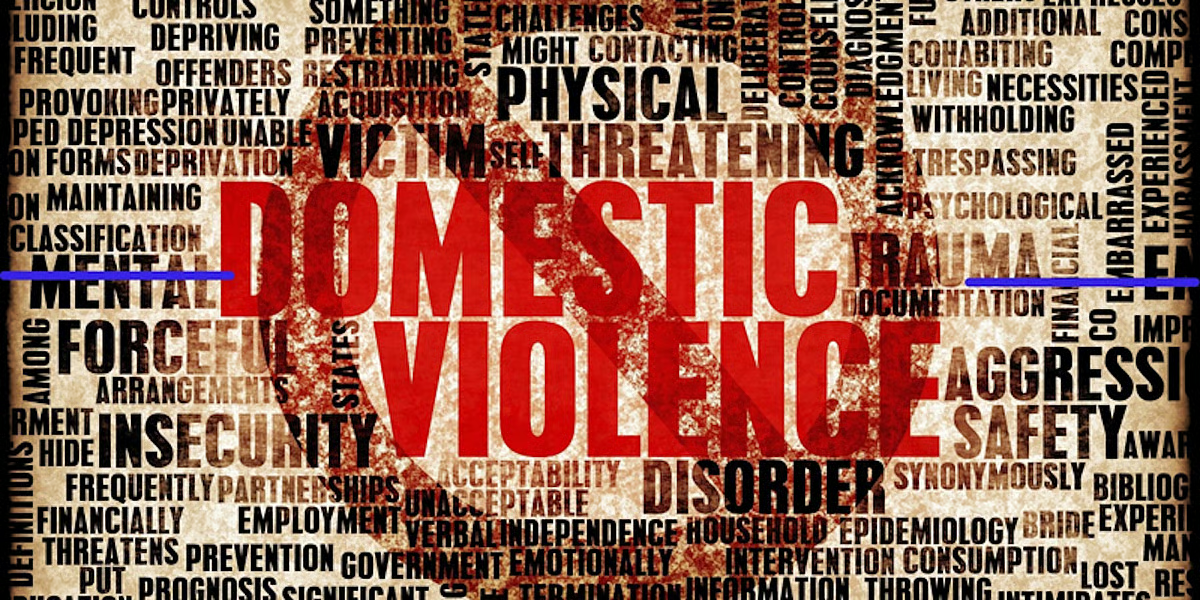
Legal Insight · Human Rights Domestic Violence in India:Seeing It Through a Woman’s Eyes A Legal and Human Perspective By Deepak | Lynx Legal Partners LLP When we hear the words domestic violence, most of us picture the same image — a bruise, a hospital, a woman with visible injuries. We picture something dramatic, something unmistakable. But in working with law and studying human rights in India, one thing becomes clear: this image, while real, is dangerously incomplete. The bruise is only the surface. Beneath it lies a world of quiet, invisible, sustained violence that millions of Indian women wake up to every single morning — and which most of them will never report, never name, and never escape. This article is an attempt to look at domestic violence honestly — through data, through law, through human psychology, and through the stories that rarely make it to court. The Scale of the Problem: What the Numbers Tell Us Before we discuss solutions, we must first accept the truth of the problem. And the truth, as research tells us, is staggering. ~30% The National Family Health Survey (NFHS-5, 2019–2021) found that nearly 30% of ever-married women in India have experienced physical, sexual, or emotional violence at the hands of their spouse. That is roughly one in every three married women in this country. What is even more troubling is what happens — or rather, what does not happen — after the abuse occurs. According to the same survey, only 14% of women who experience spousal violence ever seek any form of help. And of that 14%, very few approach the police or a court of law. The overwhelming majority suffer in silence — adjusting, enduring, and waiting for something to change. 1,36,000+ Cases registered under Section 498A IPC (cruelty by husband or relatives) in 2021 alone — according to the National Crime Records Bureau. And yet this number represents only a fraction of actual abuse occurring. For every case registered, dozens — perhaps hundreds — never reach a police station at all. What Domestic Violence Actually Looks Like One of the most harmful things we do as a society is define domestic violence too narrowly. We have built a mental image of what abuse looks like — and anything that doesn’t match that image, we dismiss. This dismissal is itself a form of violence. The Protection of Women from Domestic Violence Act, 2005 — one of the most progressive pieces of legislation in India’s history — defines domestic violence across four distinct categories under Section 3: ⚡ Physical Abuse Hitting, slapping, kicking, pushing. The visible kind — what courts see, what cameras capture. Only one part of the full picture. 🧠 Emotional & Verbal Abuse Daily humiliation, constant comparisons, threats of eviction or custody loss. Leaves no mark on the body — but marks on the mind that last far longer. ⚖ Sexual Abuse Forced physical relations, coercion, and using sex as punishment or reward. Recognised under Section 3(ii) of the DV Act — yet our criminal law remains shamefully silent on this within marriage. 💰 Economic Abuse No bank account of her own. Must ask permission to buy vegetables. Cannot visit her parents without approval. Under Section 3(iv), economic deprivation is legally domestic violence — and is reported the least. The Woman Nobody Talks About: Abuse Across Class and Education The most dangerous myth about domestic violence is that it is a problem of poverty and illiteracy. We tell ourselves a comfortable story — that educated families, urban families, and “modern” families don’t face this. This story is false. And its falseness has real consequences — because it allows abuse in “respectable” households to remain hidden behind the veil of social image. Research consistently shows that domestic violence cuts across every income bracket, every education level, every caste, and religion. A woman with a postgraduate degree, working in a corporate job, can be — and many are — in deeply abusive marriages. Her education does not protect her. In fact, sometimes it is weaponized against her: “You have a degree and you can’t even manage a home.” Her income is controlled. Her professional relationships are monitored and slowly restricted. The reason educated women stay in abusive marriages is not because they are unaware. It is because they are trapped in a different way — a career, a social identity, a reputation. They know that the moment they speak up, the world will ask: “But he seemed so decent.” This is what makes coercive control so effective — it is designed to be invisible to everyone except the person experiencing it. Why She Does Not Leave: The Barriers Nobody Addresses Perhaps the question asked most often about domestic violence — and the most unfair question — is: “Why didn’t she just leave?” This question reveals more about our ignorance than about her choices. Because leaving is not simple. Leaving requires money, safety, support, and a place to go. And in most abusive relationships, the abuser has systematically dismantled all of those. 1 Family Pressure A woman’s own family — her parents, her siblings — often discourages her from leaving. “Adjust kar lo.” “Think about the children.” “What will people say?” These words, coming from those she trusts most, carry enormous weight. And they keep her in danger. 2 Economic Dependency If he controls every rupee she spends — and economic abuse ensures he does — she has no money to leave, no money to rent a room, no money to hire a lawyer. Financial dependency is not weakness. It is a carefully constructed trap. 3 The Children Barrier “If you leave, I will take the children away from you.” Custody battles in India are long, expensive, and emotionally exhausting. Many women make a calculated decision to stay in an abusive home simply to remain close to their children. This is not surrender — this is a mother doing the only thing she can to protect her children while being trapped

Trademark Objections under Section 9(1)(b) of the Trade Marks Act, 1999
Intellectual Property Law | Trade Marks Act, 1999 Trademark Objections under Section 9(1)(b) of the Trade Marks Act, 1999 A descriptive mark that fails to distinguish — and how Indian law draws the line between brand identity and common language. One of the most common reasons a trademark application is refused in India is because the mark is considered descriptive. Under Section 9(1)(b) of the Trade Marks Act, 1999, a trademark cannot be registered if it only describes the nature, quality, purpose, value, or origin of the goods or services it represents. In simple terms, the law does not allow a business to claim exclusive rights over words that other traders may honestly need to use in the ordinary course of business. A trademark is meant to distinguish one business from another — not simply describe what is being sold. What Section 9(1)(b) Means Section 9(1)(b) applies when a mark consists exclusively of words or indications that may serve in trade to describe: —The kind of goods or services —Their quality or quantity —Intended purpose or value —Geographical origin —Time of production or any other characteristic For example, a word like “Sweet” for chocolates or “Fast” for courier services may be seen as descriptive because such words directly communicate a feature of the product rather than its commercial source. This falls under absolute grounds for refusal — meaning the problem lies in the mark itself and not because it conflicts with another registered mark. Why the Law Restricts Descriptive Marks The purpose behind this provision is to maintain fairness in the marketplace. If descriptive words were granted exclusive protection, other businesses could be unfairly restricted from using ordinary language to explain their own products. The law therefore keeps common descriptive expressions available for public use while ensuring that trademark protection is reserved for marks that genuinely identify a particular business. This protects both: Businesses Protected from unfair monopolies over descriptive language Consumers Protected from confusion in the marketplace How a Mark Becomes Descriptive A trademark may be considered descriptive when it falls into any of the following categories: It directly describes the product The mark immediately tells consumers what the product is or what it does, without any creative leap. Other traders may need the same word If competitors may reasonably need to use the same term, granting registration would be anticompetitive. It lacks distinctiveness The mark does not create a separate identity in the minds of consumers connecting it to a single source. The more directly a mark describes the goods, the greater the chance of objection under Section 9(1)(b). When a Descriptive Mark Can Still Be Registered A descriptive mark is not always incapable of protection. A mark may still be accepted if it has acquired a distinctive character through long and continuous use — known as acquired distinctiveness. In such cases, the applicant must show that consumers no longer see the mark as merely descriptive but recognize it as identifying a particular source. Evidence may include: ✓ Long-term use ✓ Advertising expenses ✓ Sales figures ✓ Consumer recognition ✓ Market reputation Without strong evidence, the objection usually remains. Judicial Approach to Descriptive Marks Courts have consistently held that a trademark should be examined as a whole and not by separating individual parts. Case Reference Navaidkhan v. Registrar of Trademarks Office Delhi High Court | 2023 The trademark “CruzOil” was refused registration on the ground that it was descriptive. The Delhi High Court held that the Registrar had taken an incorrect approach by focusing only on one element of the mark. The Court clarified: › A composite mark must be viewed in its entirety › Individual components should not be isolated › The overall commercial impression is what matters This decision reaffirmed that even if one part of a mark appears descriptive, the complete mark may still be distinctive enough for registration. Practical Importance for Businesses For businesses, Section 9(1)(b) highlights the importance of choosing a trademark carefully. Businesses that rely on purely descriptive names often face difficulty during registration and enjoy weaker legal protection later. A stronger trademark usually has: Originality Uniqueness Brand Identity Distinct Consumer Recall A well-chosen trademark should do more than describe a product — it should identify the business behind it. Conclusion Section 9(1)(b) serves an important function in trademark law by preventing the monopolization of ordinary descriptive language, while also allowing businesses to protect marks that have developed a distinctive identity over time. The real test is simple: a trademark should not merely describe a product — it should help consumers connect that product with a particular source. Thus, Section 9(1)(b) seeks to maintain a fair balance between protecting genuine brand identity and preserving common descriptive language for public use. Disclaimer: This article is intended for general informational purposes only and does not constitute legal advice. For specific legal guidance on trademark matters, please consult a qualified legal professional. SR Written by Srishti Rai Leave a Reply Cancel reply Logged in as admin. Edit your profile. Log out? Required fields are marked * Message* Δ

Community Mediation in India: Meaning, Process and Legal Framework Under the Mediation Act 2023
Community Mediation: Justice Beyond Courtrooms Legal Insight · ADR Series Community Mediation:Justice Beyond Courtrooms How the Mediation Act, 2023 empowers communities to resolve disputes through dialogue, neutrality, and social harmony. Mediation Act, 2023 · Section 43(1) Community mediation is an important mechanism for resolving disputes outside the formal court system. It refers to a process where disputes affecting the peace, harmony, or tranquillity of a community are referred to a panel of neutral mediators — who facilitate dialogue to help parties reach an amicable, voluntary settlement without resorting to litigation. Meaning and Legal Framework Community mediation is specifically provided under Section 43(1) of the Mediation Act, 2023, with a focused mandate to resolve disputes that may disturb communal harmony. If parties wish to resolve their dispute through community mediation, either party may apply to the appropriate authority under the Legal Services Authorities Act, 1987. In the absence of such authority, the application may be made to the District Magistrate or Sub-Divisional Magistrate. Procedure of Community Mediation An application is filed by one of the parties. The concerned authority receives and reviews the application. A panel of three community mediators is appointed. The mediators facilitate structured dialogue between the parties. The parties attempt to reach a voluntary settlement. The authority maintains a permanent panel of mediators, updated from time to time, to ensure readiness for community-level disputes. Who Are Community Mediators? Community mediators are generally respected members of society, chosen for their honesty, neutrality, and integrity. Their role is not to impose decisions but to guide parties toward a mutually acceptable solution. They typically include: Teachers Social workers Religious leaders Trained volunteers Features of Community Mediation Accessibility Available to all, especially those who cannot afford formal litigation. Voluntariness Participation is entirely based on the free will of both parties. Neutrality Mediators remain impartial throughout the entire process. Relationship Preservation Focuses on maintaining and strengthening social relationships. Prevention of Escalation Resolves disputes at an early stage before they intensify. Legal Status of Community Mediation Settlements ⚖ Legal Note Community mediation under the Mediation Act is designed to promote peace and harmony rather than create strict legal obligations. A settlement reached is voluntary and mutually agreed upon, put in writing, signed by the parties, and authenticated by the mediators — giving it formal recognition and evidentiary value. However, such a settlement is not legally binding in the same way as a court judgment or decree and cannot be directly enforced through execution proceedings. If no agreement is reached, the mediators submit a non-settlement report to the relevant authority, ensuring procedural closure. In essence, community mediation settlements carry moral and social binding force rather than strict legal enforceability — relying on the goodwill and cooperation of parties rather than coercive legal mechanisms. Mediation vs. Community Mediation Mediation Community Mediation Defined under Chapter II, Section 3(h) of the Mediation Act, 2023 Defined under Chapter X, Section 43(1) of the Mediation Act, 2023 General process to resolve disputes with a neutral mediator Specific type of mediation for resolving local/community disputes Covers civil, commercial, family, and other disputes Limited to disputes affecting peace and harmony in a community Can happen in courts, private centres, or online Usually happens within the local community setting Mediators are typically trained professionals or court-appointed Mediators are usually respected community members or local trained volunteers More formal and structured in approach More informal and flexible in process Primarily helps in resolving the dispute Focused on restoring peace, harmony, and relationships Deals with legal, commercial, contractual, and family matters Deals with neighbourhood, family, or local social issues Role in Communal and Social Conflicts Community mediation plays a significant role in preventing and managing communal conflicts. It helps reduce tensions between different social or religious groups by encouraging dialogue and mutual understanding. Local leaders and organisations often participate in this process, helping to build trust and prevent escalation before disputes spiral into larger conflicts. Real-World Impact: Where Community Mediation Changes Lives Land and Tribal Disputes In states like Jharkhand and Odisha, land disputes involving tribal communities, the State, and private parties are often complex and sensitive. Court processes are slow and may not fully consider local customs. Community mediation, especially under the Forest Rights Act, 2006, has helped resolve these disputes much faster through dialogue. Tribal mediators — familiar with local traditions and land practices — play a key role in reaching outcomes that are not only legally sound but also socially accepted, making mediation more effective than formal litigation in such contexts. Community Mediation vs. Court Litigation ✦ Community Mediation Informal and flexible Cost-effective and time-saving Focuses on mutual agreement Preserves relationships ⚖ Court Litigation Formal and rule-based Time-consuming and expensive Decision imposed by a judge Results in a winner–loser outcome While courts provide binding decisions, community mediation offers a more humane and cooperative approach to justice. Conclusion While court litigation ensures legally binding outcomes, community mediation provides a quicker, more accessible, and relationship-oriented method of dispute resolution. It emphasises cooperation, understanding, and social harmony — making it particularly effective for resolving community-level disputes under the Mediation Act, 2023. Published under ADR & Legal Practice Series · Mediation Act, 2023 SR Written by Srishti Rai

Why Smart Businesses Are Skipping Court and Choosing Arbitration in India
Tarikh Pe Tarikh? Why Smart Businesses Are Skipping Court and Choosing Arbitration in India If Sunny Deol’s iconic “Tarikh pe tarikh” dialogue from Damini still feels relevant in 2026, that’s because it is. India’s courts are buried under 5.4 crore (54 million) pending cases as of December 2025, and for businesses, that backlog can mean the difference between recovering dues this quarter or chasing them for the next decade. This is exactly why arbitration has stopped being a “nice-to-have” clause buried in contracts — it has become a strategic survival tool. The Numbers Don’t Lie: Why Courts Are Choking The pendency picture in India is staggering. According to the latest data placed before Parliament in February 2026, here’s where things stand as of 31 December 2025: District & Subordinate Courts: 4,76,57,328 cases pending (up 5.84% in three years) 25 High Courts: 63,66,023 cases pending (up 4.75% in three years) Supreme Court: 92,101 cases pending (up 11.40% in three years) The Allahabad High Court alone carries over 12 lakh pending cases. Uttar Pradesh’s subordinate courts groan under 1.13 crore matters. India has just 21 judges per 10 lakh people, less than half of the Law Commission’s recommended strength of 50. Land disputes alone contribute around 60% of civil litigation, and over 1.8 lakh cases have been pending for more than 30 years. For a commercial dispute worth a few crores, waiting through the court queue isn’t justice — it’s a slow death of capital. Arbitration: The 12-Month Promise Backed by Law Here’s the game-changer most business owners overlook. Section 29A of the Arbitration and Conciliation Act, 1996 (introduced by the 2015 amendment and refined in 2019) puts a statutory clock on arbitration: The arbitral tribunal must deliver the award within 12 months from completion of pleadings Pleadings themselves must be wrapped up within 6 months of the arbitrator’s appointment Parties can mutually extend by another 6 months — and that’s the outer limit without court approval If the tribunal causes the delay, the court can reduce the arbitrator’s fees by up to 5% per month Compare that with a commercial suit that can spend three years just at the trial stage, then crawl through appeals to the High Court and Supreme Court. Arbitration converts an open-ended legal saga into a defined 18-month commercial process. Why Arbitration Is Still Faster Than Courts (Despite the Critics) Yes, even the Supreme Court has its concerns. Justice Sudhanshu Dhulia recently called arbitration a “rich man’s litigation” and flagged that the Supreme Court itself was sitting on over 1,000 arbitration-related petitions. Fair criticism. But on the ground, arbitration still wins on speed for several practical reasons: 1. No Queue, No “Tarikh Pe Tarikh” In a court, your matter is one of thousands on a judge’s daily board. Hearings get adjourned because the judge is overburdened, not because your case lacks merit. In arbitration, the tribunal is hired exclusively for your dispute. Hearings happen on agreed dates, often consecutively, and matters get heard in full rather than in 5-minute slots. 2. Statutory Deadlines vs. Open Calendars Civil courts have no equivalent of Section 29A. There is no statute that says a commercial suit must be decided in 18 months. Arbitration has that hard cap built into the law itself. 3. Limited Grounds for Challenge An arbitral award can only be challenged under Section 34 on narrow grounds — patent illegality, public policy violation, or procedural unfairness. Indian courts in 2025 have repeatedly reinforced this. In Gayatri Balasamy v. ISG Novasoft Technologies Ltd. (2025), a five-judge Constitution Bench held that courts have only a limited power to modify arbitral awards. The Supreme Court has signalled clearly that judicial interference must shrink, not expand. 4. Specialised Expertise A retired judge of the Bombay High Court hearing a construction dispute, or an ex-arbitration specialist deciding an IP licensing fight, brings domain expertise that a generalist civil judge with 800 other cases simply cannot match. 5. The Institutional Push Is Real The Mumbai Centre for International Arbitration (MCIA) reported a 48% jump in new cases between 2023 and 2024, with disputes worth USD 257 million handled. Institutional arbitration is no longer experimental — it is mainstream for serious commercial players. Why Businesses Should Choose Arbitration: The Practical Case Beyond speed, here’s what arbitration buys an Indian business in 2026: Confidentiality: Court proceedings are public. Arbitration is private — your trade secrets, customer data, and commercial terms stay out of the public domain. Predictable Costs: Yes, arbitrators charge fees, but the predictable 18-month timeline often makes the total spend lower than a 7-year court battle with mounting legal fees. Enforceability: Under Section 36, an arbitral award is enforceable as a decree of the court. For cross-border deals, India’s New York Convention obligations make Indian awards enforceable in 170+ countries. Preserved Relationships: Arbitration’s less adversarial format helps when you may want to do business with the other party again. Choice of Forum and Law: Parties pick the seat, the rules, and even the language. Try doing that in a district court. Reduced Judicial Interference: The 2024 draft Arbitration Bill proposes to further restrict courts’ Section 9 powers to grant interim relief during arbitration — a clear signal that the legislative direction is toward less court intervention, not more. The Honest Caveats Every Business Should Know Arbitration in India is not perfect. A study cited by industry observers notes that nearly 48% of arbitration cases remain pending for over a year. Ad hoc arbitration (still dominant in India) often inherits the bad habits of court litigation. Section 34 challenges followed by Section 37 appeals can drag the post-award stage out. The fix is straightforward at the contract drafting stage: Choose institutional arbitration (MCIA, ICA, DIAC, SIAC) over ad hoc Specify a sole arbitrator for disputes below a threshold value to cut costs and time Build in fast-track procedure under Section 29B for claims that can be decided on documents (6-month deadline) Pick a clear seat of arbitration (Mumbai, Delhi, Bengaluru) to lock in